

Udupi: It is the nesting season and forest officials are gearing up after reports of the endangered Olive Ridley turtles coming to lay their eggs on some parts of the Kundapur coastal beaches.
Special enclosures have been set up on the beaches to protect the turtle eggs from dogs and other predators. These enclosures will help reduce the disturbance caused by humans during the incubation period.
Forest officials said that our efforts will continue until the hatchlings hatch and go to the sea.
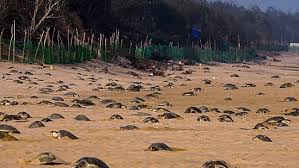
Normally, the eggs hatch in 50 days. Every year, the beaches under the Kundapur forest division are made safe during the nesting season.
Awareness programmes are being conducted among local residents and beachgoers. Lectures are being conducted on the ecological role of Olive Ridley turtles, especially their contribution in maintaining coastal balance by eating jellyfish. By consuming jellyfish, Olive Ridleys indirectly support the fishing community.
There are four species of sea turtles. Of these, the Olive Ridley turtle has the ability to come to the beach and raise its offspring. The Olive Ridley comes to the beach to raise its offspring from the Arabian Sea. The forest department is making efforts to nurture the beach-laying breeding that has been going on since the beginning of the Olive Ridley breeding.
Conservation efforts have been initiated on the coast of neighboring Dakshina Kannada, forest department sources said.


In Kundapur division, enclosures have been prepared in the Kodi Beach area, where turtles used to come in previous seasons. CCTV cameras have been installed at these places to prevent vandalism and ensure 24-hour surveillance.

Beach watchers regularly patrol the shore to identify Olive Ridley nesting activity. Local fishermen play a crucial role by keeping an eye on natural nesting sites. To encourage their participation, the department is giving Rs. 3,000 to fishermen for identifying nesting sites. Earlier, it was Rs. 2,000. Reefwatch Marine Conservation – Kundapur and other NGOs and National Service Scheme (NSS) volunteers and local residents are also part of the efforts to protect Olive Ridley eggs.


More than 100 eggs at a time
The turtles come to the beach sand to lay their eggs. Mostly during the full moon in January-February, the turtles, which come ashore amidst the sea swell, dig a hole in the sand and lay their eggs there. They lay 100 to 150 eggs at a time. Then it is covered with sand and goes back to the sea without anyone knowing. After that, these eggs remain in the sand, and after about 50 days, the young hatch from them. These young head towards the Arabian Sea and join the sea together. This is the breeding habit of the Olive Ridley sea turtle.