

Germany, Oct 21: Scientists in Germany have successfully created tiny nanodiamonds using plastic and high-powered laser beams. This research will help in understanding the process by which diamonds form deep within icy planets like Neptune and Uranus. Furthermore, it is expected that this discovery could bring about significant advancements in fields such as medicine, quantum technology, and environmental conservation.
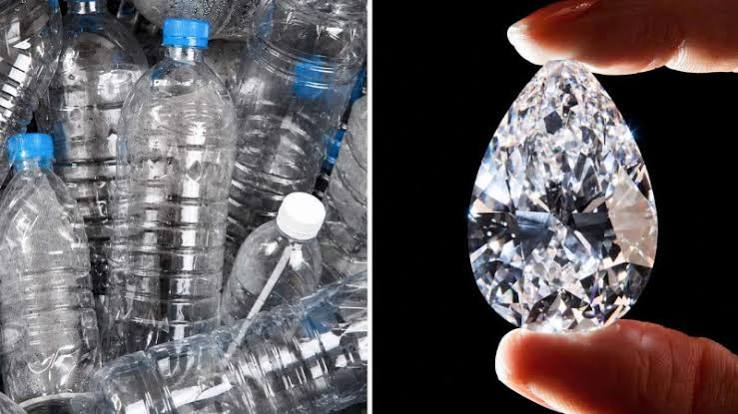
Can diamonds be made from plastic? Scientists have found an answer to this seemingly impossible question through experimentation. Researchers from the Helmholtz-Zentrum Dresden-Rossendorf (HZDR) and the University of Rostock in Germany produced these nanodiamonds by employing powerful laser technology.
The experiment was conducted at the Extreme Light Infrastructure (ELI) laser research facility, located near Prague in the Czech Republic. This research has facilitated the laboratory study of a scientific theory suggesting that, within icy planets like Neptune and Uranus—located far from Earth—carbon can transform into diamonds due to extreme pressure and temperature.
Collecting the diamonds poses a major challenge:
Beyond producing nanodiamonds using lasers, a significant challenge for the researchers was collecting them without causing damage. The microscopic diamond particles generated during the experiment were moving at extremely high speeds; capturing them safely was essential. To achieve this, scientists utilized a specialized collection medium consisting of water and ionic gels. The rapidly moving nanodiamonds became trapped within this medium, allowing for their collection and enabling further study of their structure.
Diamonds measuring just 3 nanometers:
The results obtained from this experiment have drawn considerable attention from the scientific community. According to the research, approximately 10 trillion nanodiamonds were formed with each laser shot, with each particle averaging about 3 nanometers in size. These particles are so minuscule that they cannot be seen with the naked eye. Specialized scientific instruments, including state-of-the-art electron microscopes, are used to verify their existence, structure, and characteristics.
Overall, this research—which involves producing nanodiamonds via laser technology—has opened up new possibilities for materials science, space research, and future technologies. Further studies are required to determine whether this technology can be deployed on a large scale in the future, and to assess its effectiveness within the medical and environmental sectors.