

New Delhi, Sept 16: Global temperatures are rising year by year. The ice masses and glaciers of the Himalayan mountain ranges are melting faster than ever before, causing significant concern among environmental scientists. It is fair to say that this serves as a wake-up call for India as well. Recent studies indicate that Himalayan glaciers are melting 65% faster compared to previous decades. Scientists have warned that the air pollutant ‘black carbon’ is a primary driver of this alarming phenomenon.
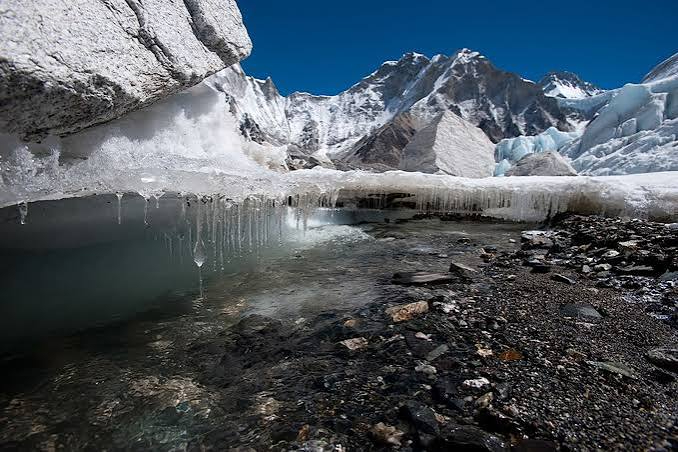
Although the Himalayan region accounts for only 18% of India’s total land area, it is the site of 35% of the country’s natural disasters. The region contributes more than 20% to the nation’s GDP. A new study has revealed that black carbon is directly responsible for approximately one-third of this glacial melting. By the middle of this century, most Himalayan rivers are expected to reach their peak water flow levels; subsequently, as glacial mass diminishes, the water flow in these rivers will decline sharply.
The country’s major perennial rivers—including the Ganga, Yamuna, Indus, and Brahmaputra—rely entirely on Himalayan glaciers. While the rapid melting of snow may lead to a temporary increase in river flow, the long-term consequence of melting glaciers is that river sources will dry up, resulting in a severe water crisis.
A Warning for India:
According to a study conducted by the global consultancy ‘Systemiq’ in collaboration with the ‘Integrated Mountain Initiative’, ICIMOD, and the ‘GB Pant National Institute of Himalayan Environment’, if current trends persist, 80% of the glaciers in the Hindu Kush Himalayas could vanish completely by 2100.
This report follows a recent tragedy in Nepal, where a catastrophic flash flood—triggered by a glacier collapse—claimed over 1,350 lives and left hundreds missing. The report warns that while there are approximately 40,000 glaciers in the Hindu Kush Himalayan region, only 21 are currently being technically monitored.
Why is Black Carbon a Threat?
Black carbon is generated from sources such as forest fires, the burning of firewood and biomass, diesel vehicle emissions, and industrial pollution in surrounding areas. These black carbon particles drift through the air and settle on the white snow. As the color black absorbs more solar heat, the surface of glaciers is heating up and melting rapidly.
Black carbon emitted from brick kilns, diesel vehicles, and forest fires is drifting through the air and settling on glaciers. This black soot accumulating on the snow absorbs more solar heat, causing the snow to melt quickly. A report indicates that black carbon is responsible for one-third of the glacial melt, a factor that can be controlled immediately.
Melting accelerates by 65%:
According to satellite data and instrumental observations, the rate of glacial melt has increased by 65% since 2010. This has dealt a severe blow to the fragile ecosystem of the Himalayas.
Escalating water crisis:
Himalayan glaciers serve as a vital water source for ten major Asian rivers, including the Ganga, Indus, and Brahmaputra. If these glaciers deplete rapidly, millions of people will face a shortage of water for drinking and agriculture in the future.
Threat of glacial lake outbursts:
Rapid glacial melting is leading to the formation of temporary glacial lakes in the high-altitude regions of the Himalayas; the risk of these lakes bursting—causing devastating floods and landslides—has increased significantly. Environmental experts have urged for the tightening of immediate global and regional climate policies to control black carbon emissions.
Millions of hectares of agricultural land in the Gangetic plains of North India—often referred to as the country’s ‘breadbasket’—depend on the waters of these rivers. A reduction in river flow could lead to a slump in agricultural production, posing a risk of a food crisis alongside water scarcity. More than 40% of India’s population—spanning Delhi, Punjab, Haryana, Uttar Pradesh, Bihar, and West Bengal—would face an acute shortage of drinking water.
Key recommendations from the report for the preservation of glaciers:
Curbing soot and pollution: Immediately controlling the emissions of black carbon and soot that reach glacier regions.