

Moodubidire: Kolar should develop strategies to conserve and manage the water that falls within its own landscape rather than depend on water diverted from elsewhere, said fiction novelist and senior scientist at the University of Agricultural Sciences, Bengaluru, Dr. K.N. Ganeshaiah.
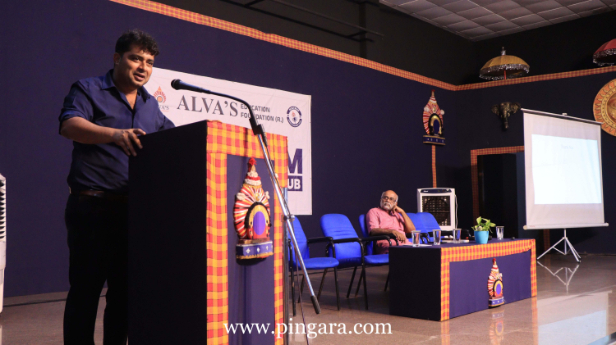
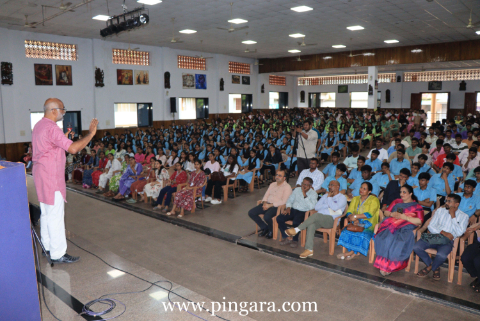
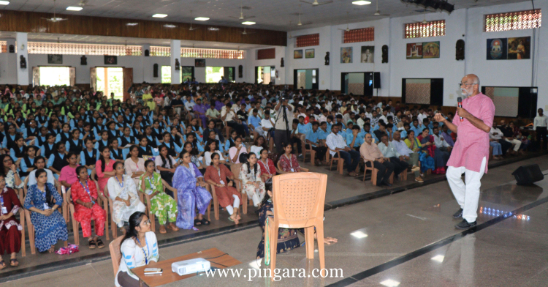
Speaking at the Rostrum program organized by Alva’s Education Foundation, on ‘Invisible Threads of Nature: The Reins of the Ecosystem’ at the Dr. V.S. Acharya Auditorium here on Tuesday, Dr. Ganeshaiah said diverting water to address the scarcity in Kolar could have ecological consequences that may not be immediately visible.
Coming from Kolar myself, I do not see this as a controversy. I have been saying for a long time that the people of the region should not depend on water brought from elsewhere. Around 2014, when I was associated with a literary program in Kolar, I openly told my own people that they should learn to conserve and manage the water that falls within their region. The water that falls on our land is our own resource. Develop strategies to harvest, conserve and recharge it, and ensure that it remains fit for human use and survival,” he said.
He urged Kolar people to strengthen its local water resources through comprehensive rainwater harvesting and conservation measures. “Do not kill the invisible threads by diverting water,” he said.
He said water systems were interconnected through several ecological processes, many of which remained invisible until they were disrupted. Engineering interventions that appeared to offer immediate solutions could, therefore, produce unintended consequences elsewhere, he cautioned.
Talakadu sand is an ecological lesson
Explaining the concept of “invisible threads”, Dr. Ganeshaiah cited the transformation of Talakadu into a landscape covered by sand. The phenomenon was traditionally attributed to the curse of Alamelamma, but scientific evidence suggested that sand accumulation had begun around 1400 AD, nearly two centuries before the alleged curse of 1610.
According to him, the construction of a dam across the Cauvery during the Vijayanagara period altered the river system and exposed sand along the riverbanks. Strong winds moving from the southwest towards the northeast subsequently carried fine sand towards Talakadu. A comparison of sand samples collected along the river towards Talakadu showed a higher proportion of fine sand in Talakadu, supporting the explanation, he said.
The movement of sand illustrated aninvisible thread– a natural process whose consequences were not immediately apparent, Dr. Ganeshaiah said. Sir M. Visvesvaraya later recognized the problem and introduced a vegetation barrier around 1940, which helped halt further movement of sand, he added. Talakadu’s transformation was not the result of a curse, but an ecological disaster brought about by human intervention, he said.
We do not know how many bamboo strips sustain us
Drawing an analogy from the story of a trekker stranded in Siberia, Dr. Ganeshaiah explained how seemingly insignificant actions could trigger a cha-in of consequences.
The trekker, unable to withstand the cold, gradually removed bamboo strips from his hut and burnt them for warmth. Eventually, the entire shelter was destroyed, leaving him exposed to the extreme cold. We do not know how many such bamboo strips are there with us on which we are all surviving, he said, stressing that several seemingly insignificant elements of nature could be essential for human survival.
He called upon the younger generation to understand and protect these ecological linkages rather than attempt to restore them after they had been irreversibly damaged. “The best way out is to hand over the whole ecosystem to the next generation as we have inherited it, without destroying anything in it,” he said.
Gadgil report sought to keep part of Western Ghats free from development
Answering a question from the audience on whether the Madhav Gadgil report was better than the Kasturirangan report, Dr. K.N. Ganeshaiah, who was a member of the Gadgil committee, said the panel’s intention was not to oppose development, but to ensure that at least some ecologically fragile parts of the Western Ghats remained free from intensive development. “We know that we need development, but at least a part of our ecosystem should be freed from development,” he said. Recalling the opposition to the report, he said the panel members faced protests and criticism, and he was even branded a “CAA agent” and “anti-national” for defending its recommendations. He said the focus should be on finding a balance between developments and protecting ecosystems that sustain society in the long term.
Presiding over the program Alva’s Education Foundation Trustee Vivek Alva said cleanliness was not merely about keeping the surroundings clean, but had to begin with the mind. Awareness of cleanliness, he said, could become a collective social practice only when it first took root in the minds of individuals. He urged young people to question not only the world around them but also themselves, stressing that keeping curiosity alive, maintaining clarity in one’s thoughts and taking responsibility for one’s actions were essential for building a better society.
Rostrum Speakers Club president Dr. Deepa Kotari, program director Dr. Ruchika Roshan and Prof. K.V. Shankar, former professor at the University of Agricultural Sciences, Bengaluru, were present.