

Delhi April 6: Ten years ago, Shimizu Corporation, a famous Japanese construction company, unveiled a plan to build a huge belt of solar panels around the moon’s equator. ‘
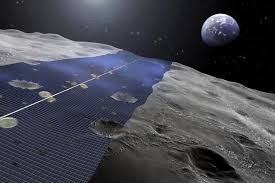
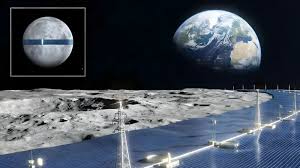
The concept, called the “Luna Ring,” would stretch for about 6,800 miles and aim to generate electricity continuously without the problems of extreme weather or darkness at night that solar power plants on Earth face. The project gained much attention after Japan’s interest in alternative energy sources intensified after the 2011 Fukushima nuclear disaster.
According to Shimizu Corporation, the same amount of solar panels installed in space could produce 20 times more energy than solar power generated on Earth. At the moon’s equator, there is no atmosphere to block the sun’s rays, no clouds, and there is no night on the side where the sun shines. This means the system could operate 24 hours a day.
“If all the energy from the lunar panels reached Earth, we would no longer need to burn coal, oil or biofuels,” said Tetsuji Yoshida, president of Shimizu’s space advisory group.
How can you get electricity from the moon to your home?
Luna The ring overcomes the biggest problem of solar energy on Earth, ‘intermittency’. Since the moon has no atmosphere, the sun’s rays are not obstructed. A part of the moon’s equator is always in sunlight, which allows for 24-hour power generation.
Solar cells on the moon’s equator convert sunlight into electricity. This electricity is brought to the ‘near side’ of the moon through cables. Transmission facilities there convert the electricity into microwave rays and high-power lasers and beam it back to Earth. Special antennas called ‘Rectennas’ on Earth capture these rays and convert them back into electricity and feed them into the grid. Shimizu aims to use this system to produce hydrogen fuel and build a fossil-fuel-free society.
Robots and lunar soil: A unique construction project
It is extremely difficult to build anything on the moon. So Shimizu is relying entirely on robots The robots are planned to be self-sufficient. They will be controlled 24 hours a day from Earth. They will do the leveling, excavation and assembly of the equipment. A small team of astronauts will support them.
Most of the materials needed for construction will be obtained on the Moon. Water, oxygen, concrete, ceramics and even solar cells can be made from lunar soil. Autonomous manufacturing units will move along the Moon’s equator, manufacturing and installing solar cells. This solar belt can be anywhere from a few kilometers to 400 kilometers wide.
Financial challenges and technical obstacles:
While all this is attractive, the biggest obstacle to this project is ‘money’. According to Masanori Komori, an economist at the Japan Institute of Energy Economics, the plan is good in theory but very expensive in practice. He argues that it would be better to prioritize geothermal energy, which is available on Earth, instead. Yoshida himself They also don’t have an exact cost estimate for the project. The technology to accurately transmit gigawatts of electricity over a distance of 238,855 miles is still in the research phase.
What’s the current status?
As of 2011, the Luna Ring Shimizu website still lists it as a hypothetical project. It has not received any official funding or official approval from Japan’s JAXA or NASA. However, discussions about such unusual alternatives have continued since the Fukushima disaster. Yoshida is not the only one who has lost faith. “If we continue to research, there is a great chance that this will become a reality,” he says.