
Mangaluru: In a remarkable story of resilience, advanced medical care and teamwork, a patient who sustained 65% deep thermal burns has recovered and returned to work following treatment at Father Muller Medical College Hospital (FMMCH), Mangaluru. The successful outcome highlights the hospital’s expertise in managing critical burn injuries and the vital role of cadaveric skin grafting in improving the chances of survival and recovery.
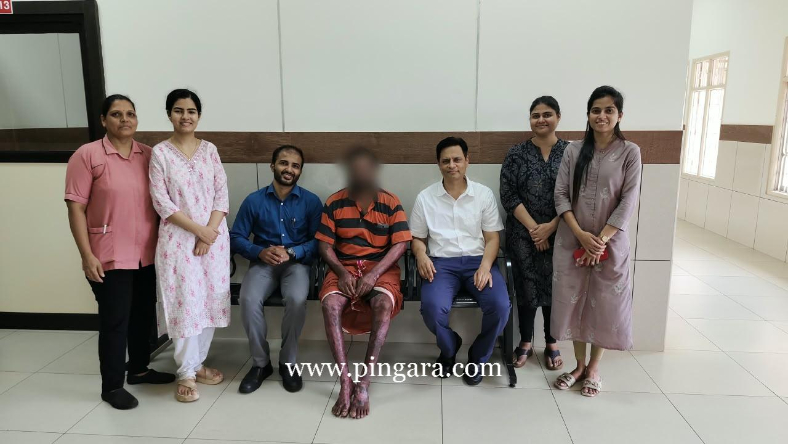
Suresh (name changed), a native of Chikkamagaluru, sustained extensive deep thermal burns following an accidental petrol spillage at his workplace. Given the severity of his injuries, he was in a critical condition on arrival at the hospital and required prompt resuscitation, intensive monitoring and specialised burn care.
The Department of Plastic and Reconstructive Surgery played a pivotal role in his treatment. The team, led by Dr Aravind Rao, Professor and Head of the Department, along with Dr Karthik Aithal, Associate Professor; Dr Akanksha Rajpoot, Assistant Professor; and senior residents Dr Chetna, Dr Manasa and Dr Ragavi, coordinated his resuscitation and a series of staged surgical procedures.
As part of the treatment strategy, cadaveric skin grafting was performed during the initial phase, followed by grafting using the patient’s own skin. This staged approach helped support wound management and healing, contributing to a favourable treatment outcome. With sustained medical attention and dedicated care, Suresh gradually recovered from the life-threatening injuries and has now resumed his work.
Expressing his gratitude, he thanked the doctors, nurses and the entire hospital team for their dedicated care and support throughout his treatment and recovery.
A significant contributor to the management of burn injuries at the institution is the Father Muller Rotary Skin Bank, established in collaboration with Rotary Mangalore. The skin bank has helped make cadaveric skin grafts available to patients at subsidised costs, strengthening the hospital’s capacity to provide specialised treatment for severe burns. Cadaveric skin grafts serve as a valuable temporary wound covering, helping protect burn wounds and support subsequent treatment, including definitive grafting with the patient’s own skin where required.
Emphasising the importance of skin donation, the institution calls for greater public awareness and participation in cadaveric skin donation. Increased donations can help make this life-saving resource available to more patients with extensive burns, improving their prospects of healing and recovery.
Rev. Fr Faustine Lucas Lobo, Director, Father Muller Charitable Institutions (FMCI), and Rev. Fr George Jeevan Sequeira, Administrator, FMMCH, expressed their happiness at seeing a patient with burns covering over 65% of his body recover and return to work, once again enabling him to fulfil his role as a provider for his family. His recovery, they noted, reflects the commitment of the institution to providing compassionate, specialised and patient-centred healthcare.
The successful outcome stands as a testament to the dedication and coordinated efforts of the doctors, technicians, nurses and allied healthcare personnel who work tirelessly to provide comprehensive care to critically ill patients. Their collective commitment, supported by the facilities and expertise of the hospital’s Burn Intensive Care Unit (BICU), continues to offer hope to patients facing some of the most challenging medical emergencies.
For Suresh, the journey from a critical condition to returning to his livelihood is more than a medical recovery after 2 months of exhaustive treatment at Father Muller —it is a renewed opportunity to live, work and care for his family.