

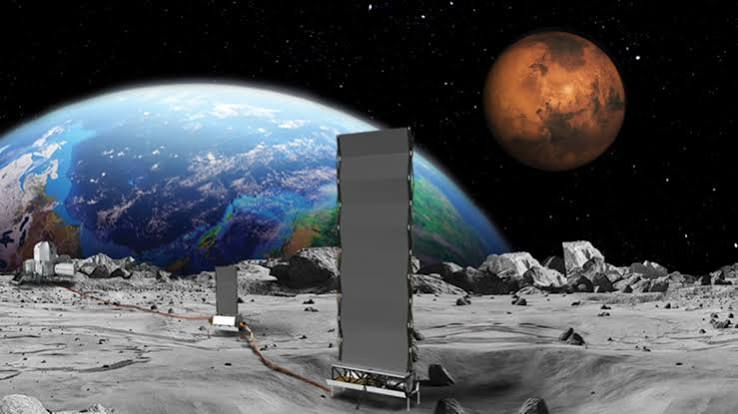
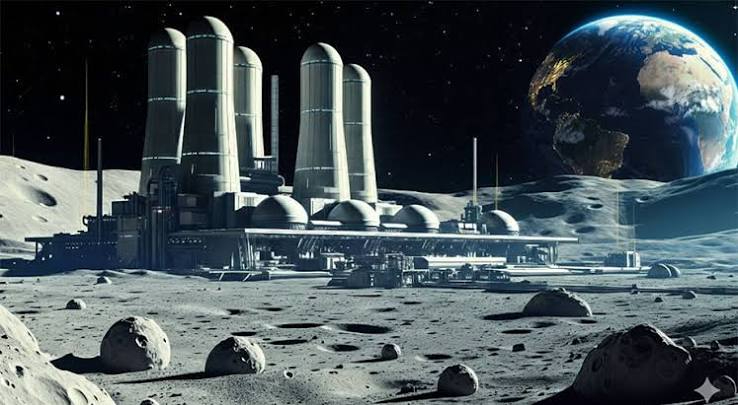
New Delhi, Oct 5: As plans to establish permanent bases on the Moon gain momentum, a race has begun to develop nuclear reactors capable of providing a continuous power supply there. The US, China, and Russia view nuclear energy as a key option for future lunar missions. NASA and the US Department of Energy are working on developing a fission power system for the Moon. NASA aims to demonstrate a nuclear reactor on the lunar surface by 2030. Such a system would be capable of providing uninterrupted electricity even in the absence of sunlight.
Why is nuclear power needed on the Moon?
Day and night cycles on the Moon are much longer than those on Earth; specifically, the lunar night lasts for about 14 Earth days. During this period, generating electricity using solar panels becomes difficult. Only a nuclear reactor can provide continuous power without relying on sunlight.
This electricity could be used to power equipment, rovers, and scientific experiments at lunar bases, as well as to meet the needs of future astronauts. NASA has previously worked on concepts for a reactor with a 40-kilowatt capacity. Such a system is designed to provide continuous power for many years.
Safety is a major challenge:
Installing a nuclear reactor on the Moon is no easy task. The reactor must be transported from Earth via rocket. If an accident occurs during launch, the safety of the nuclear materials becomes a critical issue.
Installing the reactor on the lunar surface and shielding astronauts and equipment from its radiation poses another significant challenge. NASA’s designs place special emphasis on safety and radiation control.
A New Space Race on the Moon
As plans to establish a base at the Moon’s South Pole progress, activities such as power generation, the utilization of water ice, oxygen production, and the exploration of other resources are likely to accelerate. NASA has also invited new proposals for the power systems and technologies required to build a future lunar base at the South Pole by 2026. Thus, alongside the race to establish a human settlement on the Moon, a global competition has begun regarding the power supply needed for that base.