

Islamabad (Pakistan), 10: Army Chief Field Marshal Asim Munir is orchestrating a grand plan to transform himself into Pakistan’s dictator and reduce the entire nation to a puppet of the military. He aims to achieve this by reorganizing the country’s four existing major provinces into 12 to 15 smaller administrative units. Here is a report on the matter:
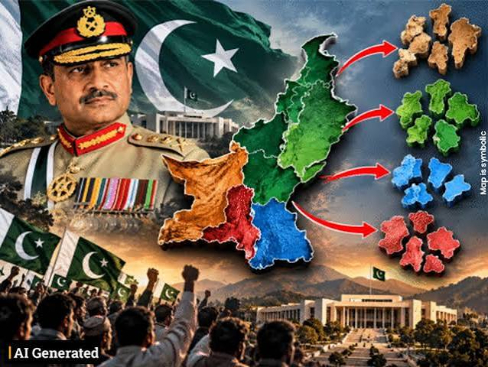
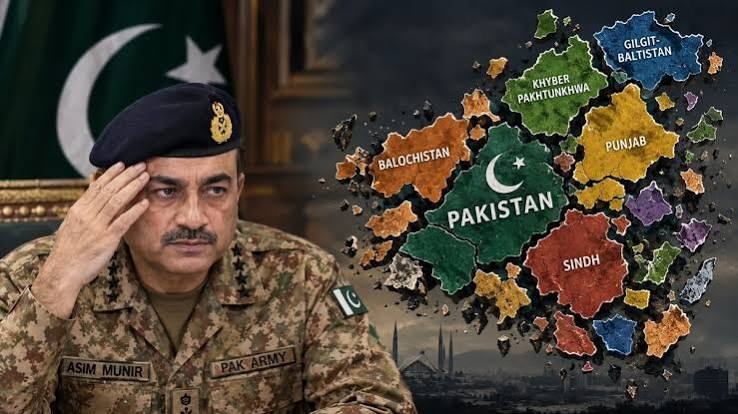
Adopting the British policy of “divide and rule,” Asim Munir is devising this plan to reorganize or split Pakistan’s four major provinces—Punjab, Sindh, Khyber Pakhtunkhwa, and Balochistan—into 12 to 15 smaller administrative units through a proposed 28th Constitutional Amendment. Accordingly,
Punjab Province: West Punjab, South Punjab, Bahawalpur, and Pothohar
Sindh Province: Karachi/Lower Sindh, Upper Sindh, and Mehran
Balochistan Province: Balochistan and Makran
Khyber Pakhtunkhwa (KPK): Khyber, South KPK, Hazara, and Kohistan
What is the reason for the division?
Administrative Imbalance: Pakistan’s provinces vary vastly in size and population. For instance, Punjab alone has a population of 128 million (12.8 crore), accounting for more than half of the country’s total population. Conversely, while Balochistan is large in terms of geographical area, it has a population of only 15 million (1.5 crore).
Lack of Services: Due to the large size of the provinces, people in rural areas often lack basic amenities like drinking water and education, and they have to travel for hours for government-related work. The army argues that smaller provinces would facilitate easier administration.
Furthermore, analysts suspect that the true motive behind this division is not administrative reform, but rather to weaken the strength of regional political parties. Accordingly, Nawaz Sharif’s PML(N) holds a strong grip in Punjab, while the Bhutto family’s PPP dominates Sindh. There is an apprehension that if provinces were to be made smaller, these political power centers would weaken, leaving the entire country completely at the mercy of the army.
However, under Article 239 of Pakistan’s Constitution, altering the boundaries of any province requires a two-thirds majority in both the National Assembly and the Senate, as well as the consent of two-thirds of the concerned provincial assembly. Notably, on September 3, the Sindh Assembly passed a unanimous resolution explicitly rejecting the division of the province.