

New Delhi: Air pollution in the national capital, New Delhi, has reached a critically dangerous level, with the overall Air Quality Index (AQI) climbing to 482 on Thursday morning. The Central Pollution Control Board (CPCB) has announced that Delhi has consequently slipped into the ‘severe’ and ‘hazardous’ pollution zone.
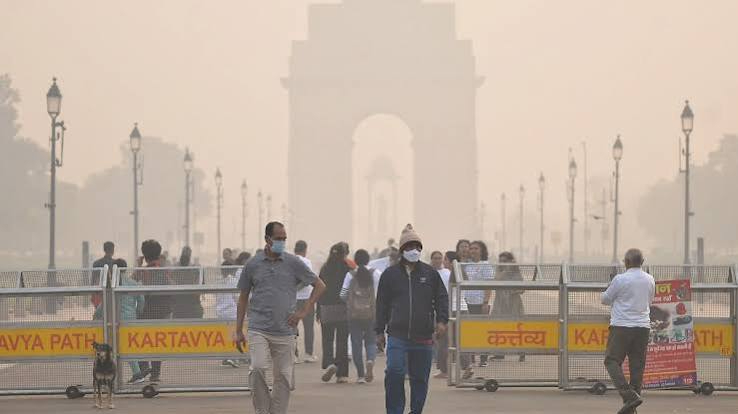
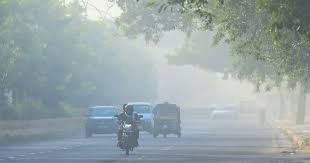
According to data released by the Central Pollution Control Board (CPCB), the AQI has exceeded 400 at seven air quality monitoring stations across the city—an indicator of severe air pollution.
The highest AQI was recorded in Punjabi Bagh at 446, followed by Narela (434), Rohini (431), R.K. Puram (416), Bawana (412), Delhi University’s North Campus (408), and Patparganj (405).
In several other parts of the city, air quality remains in the ‘very poor’ category. An AQI of 399 was recorded in both Okhla Phase-2 and India Gate, while the levels stood at 397 at ITO and 396 in Dwarka Sector-8. An index value of 356 was recorded in Chandni Chowk, and 330 in Vasundhara Enclave.
An AQI of 293 was recorded in Anand Vihar, while a reading of 268 was noted at the India Meteorological Department (IMD) center on Lodhi Road. Both these areas fall under the ‘poor’ air quality category.
Pollution levels have risen as the festival of Diwali approaches, and forecasts suggest that the situation may deteriorate further in the coming days.
According to the Air Quality Early Warning System, Delhi’s air quality is likely to reach the ‘severe’ category again on November 6 and 7. This condition is expected to persist for the following six days.
Data from the Central Pollution Control Board indicates that Delhi’s average AQI on Wednesday stood at 377—the worst level recorded in the last 288 days.
The rise in pollution is attributed to local pollutant emissions, the burning of agricultural waste in neighboring states, and adverse weather conditions that hinder the dispersion of pollutants in the atmosphere.
Emissions from residential areas, industrial activities, construction work, and road dust are also contributing factors to the pollution. According to satellite data from the Indian Agricultural Research Institute, a total of 467 farm fire incidents were recorded across six states on November 4. Specifically, 157 incidents were detected in Madhya Pradesh, 151 in Punjab, 111 in Rajasthan, 33 in Uttar Pradesh, 10 in Haryana, and five in Uttarakhand. No farm fires were detected in Delhi.
Meanwhile, the Commission for Air Quality Management (CAQM) has further tightened measures to curb the burning of agricultural waste in Punjab. Citing a failure to prevent farm fires, the Commission issued show-cause notices on Wednesday to the District Collectors and Senior Superintendents of Police of Jalandhar, Faridkot, Bathinda, Barnala, and Fazilka districts. Similar action was taken against officials in four other districts earlier this week.
Concurrently, adverse weather conditions have further exacerbated pollution levels. Due to low wind speeds, light fog, and seasonal changes, pollutant particles in the atmosphere are failing to disperse and are instead accumulating close to the ground.
Measures under Stage-2 of the Graded Response Action Plan (GRAP) for air pollution control are already in effect in the Delhi-NCR region. Under this initiative, measures have been taken to intensify mechanical road cleaning, spray water using dust-suppression equipment, tighten inspections at construction sites, and control pollution arising from road dust and vehicular emissions.
Union Environment Minister Bhupender Yadav stated on Tuesday that the Centre’s Commission for Air Quality Management is continuously monitoring meteorological conditions—including wind direction, speed, and atmospheric movement—and is implementing necessary measures based on its assessments.
The government reports that incidents of agricultural waste burning have decreased compared to previous years.