

New Delhi, July 13: The Supreme Court today stayed the Madras High Court order completely banning cow slaughter across the state of Tamil Nadu on the eve of Bakrid festival. A bench of Supreme Court Justices Vikram Nath and Sandeep Mehta issued this important order. With this, the door has now been opened to a huge administrative and legal mess that had been created in Tamil Nadu.
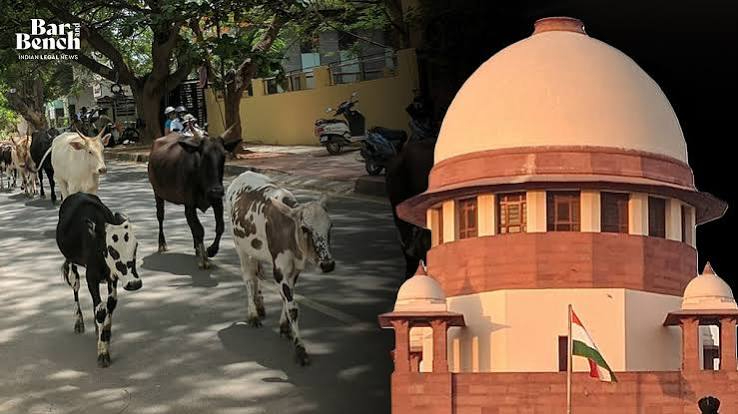
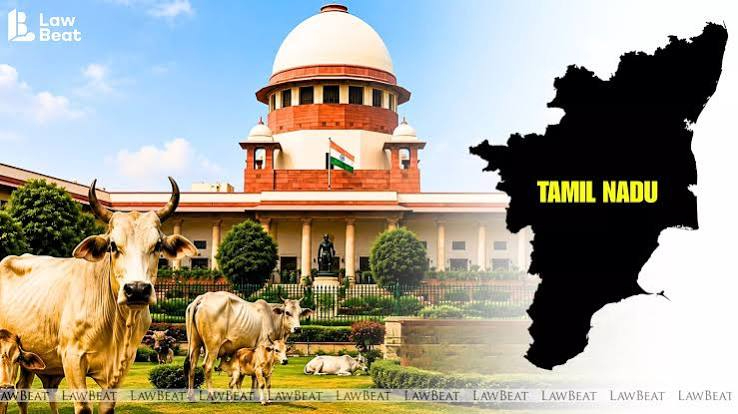
Senior advocate Dr. Abhishek Manu Singhvi made a strong submission in the Supreme Court on behalf of the Tamil Nadu government’s Special Leave Petition (SLP) challenging the High Court’s verdict.
Order beyond the legal framework: The government argued that the High Court order is completely against the ‘Tamil Nadu Animal Protection Act, 1958’ in force in the state. According to this law, cows that are over 10 years old, unfit for agricultural work and breeding can be slaughtered in specified slaughterhouses after obtaining a certificate from the competent authority.
The judiciary cannot make laws: While the statutory law provides for certain exemptions, the state government had objected that the High Court was going to do the work of the legislature by imposing a ‘complete ban’ beyond all that.
Judgment beyond the scope of the petition and internal contradiction
K. Surya Prashanth, general secretary of Hindu Makkal Katchi, had filed a public interest litigation (PIL) only to prevent cow slaughter in public places during Bakrid in Coimbatore.
However, a division bench of the High Court comprising Justices G.R. Swaminathan and V. Lakshminarayan had extended the scope of the order to include cow slaughter in authorized slaughterhouses across the state, despite the petitioner’s objection. Surprisingly, the High Court, in one part of its judgment, said that “animals can be slaughtered only in designated slaughterhouses”, while in another part it said that “cows or calves should not be slaughtered on any day”. It was because of such internal contradictions that the Supreme Court stayed this.
Old government order of 1976 has no value
The High Court had given this judgment based on an old government order of 1976 stating that a ban on cow slaughter was necessary to improve milk production and the rural economy. However, the Tamil Nadu government objected that the validity of this old order was never discussed before the court and no notice was given to the government before its implementation. The Supreme Court has accepted that no old administrative instructions can override the statutory laws currently in force.
Ban on slaughter in public places to continue
Although the Supreme Court has stayed the complete ban of the High Court, it has maintained the ban on slaughtering animals in public places.
This means that the previously regulated rules in Tamil Nadu will continue. No religious animal sacrifice can be performed on roads, parks or in public places. Only in closed, non-public places or government slaughterhouses is animal slaughter allowed under the legal framework. In Tamil Nadu, the issue of cow slaughter has always been a sensitive one, between Dravidian politics and religious traditions.